 Conroe Mobile RV Repair
RV Roof Repair and Resealing in Conroe
Almost every RV roof leak starts in the same place: a joint where the roof is penetrated by something, sealed with lap sealant, then baked by Texas sun and eventually tested by rain. The membrane usually outlives the sealant by years. Catch it at the sealant stage and you are looking at $500 to $1,200 for a reseal; wait until the membrane fails and the decking is wet, and it becomes $2,000 to $3,000 or more.
Check this first (fifteen minutes, if the roof is walkable)
Only go up if your roof is rated to be walked on and you are comfortable up there, and never with a storm in the forecast.
- Look at every penetration. Roof vents, the rooftop AC, skylights, the refrigerator vent, antennas, and the front and rear caps. Sealant that has gone chalky, shrunk away from the flange, cracked into a crazed pattern, or discolored along the edge has failed, whatever it looks like from ten feet away.
- Push your thumb into the seam sealant. Healthy sealant gives a little. Hard, brittle, glassy sealant is done.
- Notice any spot that feels soft while you walk the roof. Anything that flexes underfoot means water has reached the decking, which changes the job.
- Inside, find any stain and work uphill. Water travels along framing and can surface several feet from where it entered. A musty smell with no visible stain is also worth checking; in Gulf Coast humidity, mold can arrive before a stain does.
- Check the AC gasket. A rooftop AC seals to the roof with a compressible gasket, not sealant, and it takes a set over the years. Water around the AC shroud is more often the gasket than the roof.
What is usually wrong
| What you find | Likely cause | Fix and cost |
|---|---|---|
| Cracked, chalky, or discolored sealant at vents and seams | Normal UV and rain failure on a Texas rig | Reseal $500 to $1,200 |
| Water around or under the AC | Compressed AC gasket | Gasket replacement, often $200 to $450 |
| Stain at a slide edge only when it rains | Slide seals, not the roof | Slide seals |
| Soft, flexing roof underfoot | Wet decking, membrane failure | Structural repair $2,000 to $3,000+ |
| Bubbles or wrinkles in the membrane | Delamination from the decking | Inspect before quoting; often the larger job |
| Stain around a window or on the sidewall | Window or trim sealant, not the roof | Sealant work, often $200 to $600 |
| Torn membrane or missing vent cover after a storm | Wind damage | Assess and document for insurance |
Those ranges are from the pricing page, on top of the $75 to $150 trip fee and $125 to $190 hourly labor.
Why Montgomery County roofs fail this way
Two things work on a roof here, and they take turns most of the year. Texas sun bakes the sealant and drives out the plasticizers that keep it flexible. Then the wet season tests it: Montgomery County’s wettest stretch typically runs well over 5 inches of rain in its heaviest month, and the muggy period runs from roughly mid-April to late October. Sealant that was merely cracked in spring is a leak by midsummer.
Then there is hurricane season, June 1 through November 30. Hurricane Beryl came ashore as a Category 1 storm on July 8, 2024, and Conroe took heavy rain and wind gusts near 70 mph; the city logged widespread tree and utility damage and signed a disaster declaration the same day. A rig parked through an event like that has had its vent covers, antenna mounts, and every seam worked by wind and driven rain, and the right move afterward is an inspection, not an assumption.
What a proper reseal involves
The labor is in the preparation, not the caulk. Failed sealant gets dug out rather than covered, the substrate is cleaned back to a surface new sealant can actually bond to, and then the correct product goes on: self-leveling sealant on horizontal surfaces and non-leveling on vertical ones, matched to your roof material. EPDM, TPO, and fiberglass roofs do not all take the same products, and using the wrong one is how a reseal fails in a year.
While we are up there, the AC gasket, vent covers, and skylights get checked too, since the trip and the ladder are most of the cost of dealing with any of them.
Wet decking under the sealant
A roof that gives underfoot, or a ceiling panel gone spongy, tells you water has sat in the structure long enough to soak the wood. At that point we talk through a larger job, including whether an older rig is worth putting it into at all. Expect that assessment straight; a reseal over rotten decking is not a repair.
What to expect on the call
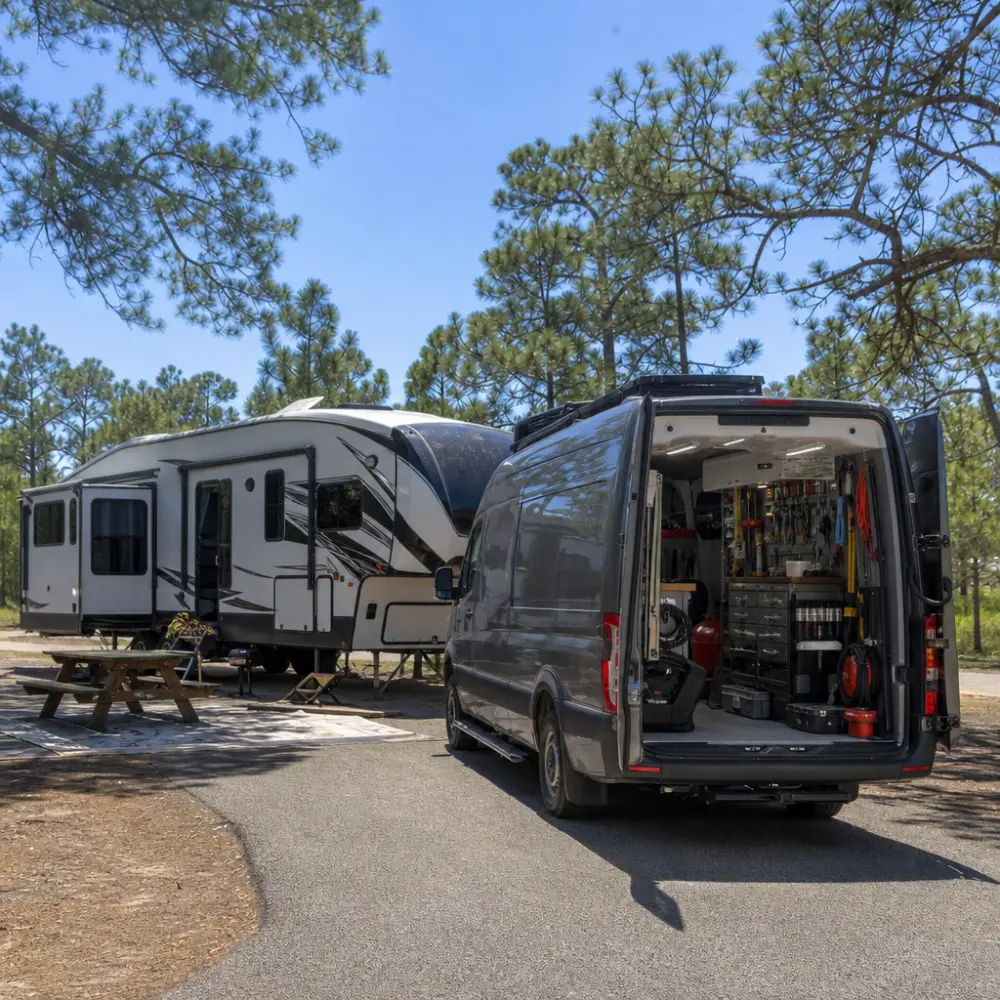
Photos of any interior stain and of the nearest roof penetration are worth a lot. Include the rig’s age, the roof material if you know it, and whether the leak shows up in rain or all the time. Mobile roof work happens at lake houses, storage yards, and driveways across Conroe, Montgomery, Willis, The Woodlands, Magnolia, New Caney, and Huntsville. For a reseal figure sized to your rig, try the roof cost calculator.
Frequently Asked Questions
How much does an RV roof reseal cost in Conroe?
$500 to $1,200 for a typical rig: digging out failed lap sealant, cleaning the substrate, and resealing vents, skylights, and seams. If the membrane itself has failed or there is wood rot in the decking, that runs $2,000 to $3,000 or more, and you should know which one you have before anyone quotes.
When should I get the roof resealed before hurricane season?
Spring, before the wettest months and before hurricane season opens June 1. Sealant needs a dry window to cure, and Texas sun works on it hardest through spring, so catching cracked sealant before the season tests it is the cheapest version of this job.
My rig sat in a storage yard for months. Does the roof need checking even with no obvious leak?
Yes. Sealant fails silently. A rig that has not been walked or inspected in months can have cracked, chalky sealant at every penetration with no visible leak yet, because it has not rained hard enough to find the gap. A roof inspection before you take the rig out is cheap insurance against finding a stain on the first trip.
Can you really fix a roof on site, or does it need a shop?
The large majority of roof problems are resealing, which is entirely mobile work: dig out, clean, reseal. What needs a shop is structural repair after wet decking has been left untreated for a long time, or full membrane replacement on an older rig. An honest inspection tells you which one you have.
More rvrepair services
- Mobile RV Repair in Conroe: We Come to the Rig
- RV Air Conditioner Repair in Conroe, Texas
- RV Slide-Out Repair in Conroe: Motors, Mechanisms, Seals
- RV Plumbing and Water Heater Repair in Conroe, Texas
- RV Appliance and 12V Repair in Conroe: Fridges, Furnaces, Converters
- RV Fiberglass and Delamination Repair in Conroe
- RV Generator Repair in Conroe
- RV Electrical Repair in Conroe
- RV Maintenance and Seasonal Service in Conroe